Concrete driveway joints are the lines or separations placed in a driveway to help the concrete handle movement. They may look simple, but they play an important role in how the slab responds to shrinkage, temperature changes, vehicle traffic, and Minnesota weather.
A good driveway is not only about the concrete mix or finish. Joint layout, saw-cut timing, spacing, slope, and base prep all affect how the surface performs over time. At Cornerstone Concrete, we help homeowners understand why joints are planned into the driveway from the start.
What Are Concrete Driveway Joints?
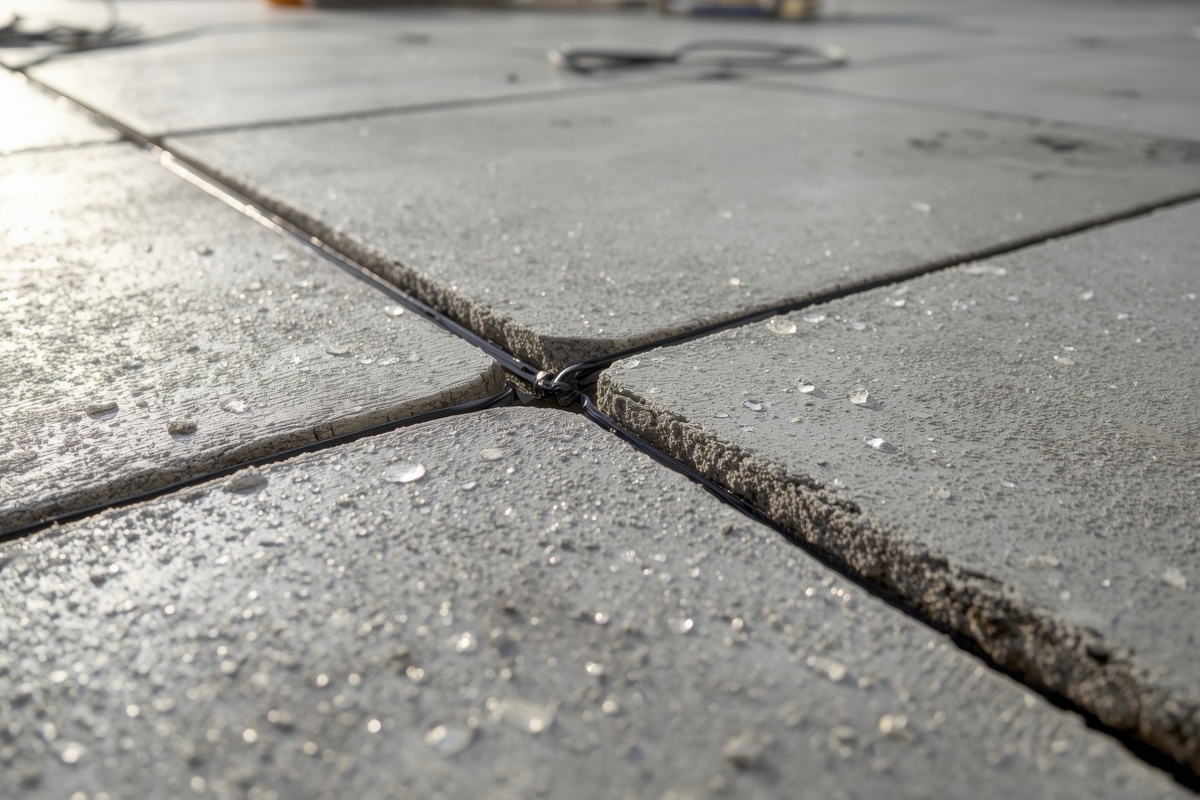
Concrete driveway joints are planned cuts, grooves, or separations that control where the slab moves and where it cracks. Control joints do most of that work, steering shrinkage cracks into lines somebody chose rather than letting them wander across the slab. ACI puts conventional saw cuts at about one-fourth of the slab depth, made 4 to 12 hours after the pour. Cut too early, and the edges ravel. Cut too late, and the concrete has already decided where it wants to crack.
These joints do not mean the driveway was installed poorly. Concrete naturally shrinks as it cures and expands or contracts with temperature changes. Joints give that movement a more predictable path, which can help protect the overall appearance and performance of the driveway.
Why Concrete Driveway Joints Matter in Minnesota
Minnesota driveways take large temperature swings, snow, ice, deicing salt, spring thaw, and repeated freeze-thaw cycling. The weather also moves the cut window itself. ACI notes that hot conditions can pull it in to within an hour of placement, while cold weather stretches it back toward four. A July pour and an October pour are not the same job.
Driveway joints also matter because the surface carries vehicles, snowblowers, shovels, and seasonal wear. A well-planned joint layout can help panels move more predictably and reduce the chance of random cracking across large open sections.
What Types of Concrete Joints Should Homeowners Know?
You do not need the whole vocabulary. Three types cover nearly everything you will see in a driveway, and each one solves a different movement problem. Layout shifts a little depending on the type of driveway you are building, too, since the surface finish affects how visible the cuts are.
Control Joints
Concrete driveway control joints are the most common lines homeowners notice. They are placed to guide shrinkage cracks into planned locations as the concrete cures and responds to movement.
A control joint is either tooled into fresh concrete or saw-cut after the pour. The goal was never a crack-free driveway. It is cracks that land on the line you put there. Cuts planned well read as part of the driveway’s design rather than as damage.
Expansion or Isolation Joints
A concrete expansion joint, often better described as an isolation joint in many driveway situations, separates the driveway from fixed surfaces. These may include the garage slab, foundation, sidewalk, steps, or other concrete that should not be locked tightly to the driveway.
This separation gives the driveway room to move without pushing directly against another structure. It can also help reduce stress where different surfaces meet.
Construction Joints
Construction joints may appear where one concrete placement ends and another begins. They are more common on larger or staged projects, but homeowners may still notice them where driveway sections meet.
A construction joint should be planned and finished carefully so it does not become a weak or awkward transition. Like other joint details, it works best when it is part of the project layout rather than an afterthought.
The main point is simple: different joints solve different movement problems. A clean driveway layout uses the right joint in the right place.
Do Joints Prevent Every Concrete Driveway Crack?
Concrete driveway joints help manage cracking, but they do not guarantee a crack-free driveway. Concrete can still crack because of base movement, heavy loads, poor drainage, tree roots, severe freeze-thaw stress, or other site conditions.
A crack running down a control joint is the joint doing its job. What deserves a look is one that wanders across a panel, one that keeps opening, or a slab that has started to heave or settle. Settling is worth diagnosing early, because leveling and replacement are different conversations at very different costs.
Should You Seal Concrete Driveway Joints?
Sealing keeps water, grit, and sediment out of the joint. That matters here more than in most places, because anything that gets in and then freezes works the joint a little wider every winter. Whether a particular joint should be sealed depends on its type and condition.
Sealing is not a cure for structural movement. If a joint is widening, the driveway is settling, or cracks are spreading outside the planned joint layout, concrete driveway crack repair or replacement planning may need to address the underlying cause, not only the open gap.
How Cornerstone Concrete Builds Joint Planning Into Your Driveway
Cornerstone Concrete treats joint layout as part of the driveway plan, not as a final detail added after the concrete is placed. Before the pour, we look at the driveway shape, garage transition, apron area, slope, and panel layout.
Our joint planning may include:
- Reviewing the driveway layout before forms are finalized
- Planning control joints around panel size and driveway shape
- Coordinating cuts with garage, apron, and edge transitions
- Considering slope and drainage before the concrete is finished
- Explaining what normal joint behavior may look like over time
Good joint planning supports the performance benefits of a well-built concrete driveway. If replacement is on the table, our installation process covers what happens before and after the pour, including joint layout.
Seeing Cracks Near Your Driveway Joints?
Some cracks near joints are part of how concrete moves, but others deserve more attention. Widening cracks, uneven slab edges, heaving, settling, or joints that hold water may point to movement, drainage trouble, or a driveway that is reaching the end of its useful life.
If you are not sure whether you are looking at sealing, a repair, or a replacement, contact Cornerstone Concrete. We will look at the joints, the cracks, and the slab, then tell you which of the three it is. Driveway pricing is worth a look before you plan the next step.