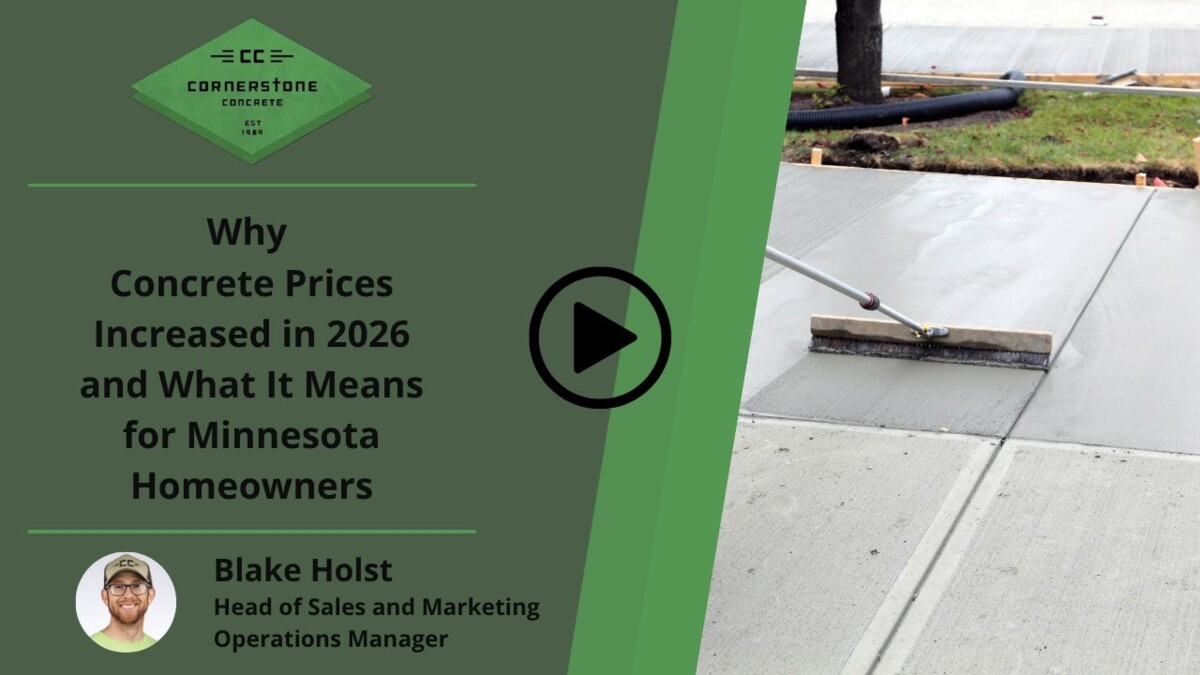
Concrete prices went up again in 2026, and the increase was neither a local quirk nor a contractor markup. Federal price data shows ready-mix concrete climbing steadily, driven by what it costs to produce cement, run a plant, pay a crew, and deliver a load. The forces behind it sit well upstream of any Twin Cities driveway.
The useful question for a homeowner is not whether prices rose, but what the pattern looks like over time and what it means for a project you are weighing.
What the Price Data Actually Shows
The federal government tracks this directly. The Bureau of Labor Statistics maintains a producer price index for ready-mix concrete, published through the St. Louis Federal Reserve, and it is the cleanest available picture of what concrete costs before any contractor touches it.
The Trend Since 2020
The ready-mix index rose about 31 percent over the five years to September 2026, with most of that concentrated in 2022 and 2023. The pace has slowed considerably since: roughly 6 percent across the last three years, and 2.3 percent in the twelve months to September 2026. These are producer-level numbers, meaning they reflect the cost of the material itself, separate from labor, equipment, or site work.
Why It Rarely Reverses
Concrete prices almost never fall, though they can stall. After the 2008 housing collapse, the index sat essentially flat from 2008 through 2011, which is the closest thing to relief the last two decades produced. The reason is the structure of cement production. Plants carry enormous fixed costs and run most efficiently at steady output, so when demand softens, producers generally trim production rather than cut prices. Anyone predicting a drop is predicting something the industry has not done in a very long time.
What Is Actually Pushing Costs Up
Several inputs move at once, which is why the increases arrive steadily rather than tied to any single headline.
Cement and Material Production
Making cement is energy-intensive. Kilns run at extreme temperatures, and the cost of that energy flows straight into the price of every yard. Partly in response, the industry has moved toward fly ash, slag, and new concrete mixes. We still pour straight Portland for driveways.
Aggregate carries its own costs in mining, processing, and permitting, and new capacity takes years and enormous capital to bring online, so supply cannot respond quickly to price. That pressure is why recycled aggregate driveways come up, and why we specify natural river rock instead.
Labor
Skilled concrete crews are harder to find and cost more to keep than they did five years ago. Paying experienced people a living wage is a real and growing share of any project, and it is not a line item we would want to cut. Finishing quality depends entirely on who is holding the tools.
Delivery and Trucking
Ready-mix has a short working life, so it travels on a clock in specialized trucks with drivers who have to be there when the pour is. Fuel, equipment, insurance, and driver wages all feed into what a load costs to land on your site.
Concrete Does Not Swing With Fuel the Way Asphalt Does
Worth knowing if you are comparing surfaces: asphalt binder is a petroleum product, so asphalt pricing tracks the oil market fairly directly and can move sharply in either direction within a season. Concrete is not immune to energy costs, since cement production and trucking both consume plenty, but it does not rise and fall with crude the same way.
The practical difference is predictability rather than cheapness. Concrete pricing tends to grind upward in small steps instead of spiking, which makes it easier to plan around even when the direction is unwelcome.
What a Driveway Costs in the Twin Cities Right Now
Homeowners deserve a real starting figure rather than a runaround. Most tear-out and replacement work runs 10 to 14 dollars per square foot in 2026, and the figures below are starting points for a conversation rather than quotes.
Standard Two-Car Driveway
A 20-by-40-foot driveway, about 800 square feet, runs roughly 9,600 to 11,800 dollars. That covers the ordinary case: a straightforward tear-out, a properly compacted base, and a standard finish on a site the trucks can reach without difficulty.
Three-Car Driveway
A 30-by-40-foot driveway, about 1,200 square feet, runs roughly 13,500 to 16,200 dollars. The jump is not purely a function of added square footage, since larger pours often bring wider aprons, longer approaches, and more jointing to plan around.
What Moves Your Number Off the Average
Square footage, demolition and disposal, site access, base correction, drainage work, reinforcement, and finish choice all shift the total in either direction. What concrete driveway installation and replacement actually includes is worth understanding before you compare two bids, because the cheaper proposal frequently leaves out work that the other one priced in.
How to Manage the Cost of Your Project
Rising prices are not a reason to panic, but they do reward homeowners who plan deliberately rather than react.
- Get the number before you need it: Estimates are free, and knowing the real figure lets you budget against something concrete instead of a guess from the internet.
- Do not defer indefinitely without a reason: Given a trend that has been upward for two decades, waiting several years has historically meant paying more, not less. If the project is inevitable, delay usually costs something.
- Scope honestly: Square footage is the largest lever you control. A slightly smaller footprint, or a standard broom finish instead of decorative work, changes the total more than most homeowners expect. Exposed aggregate vs. stamped concrete both sit above a broom finish either way.
- Ask about payment options: We do offer financing, including promotional-rate programs. Terms, qualifying conditions, and the current offer change over time, so ask us directly and review the details with the lender before committing.
None of this is financial advice, and we are not the right people to tell you what should be on a credit line. What we can do is give you an accurate, itemized number so the decision is an informed one. You can review concrete driveway costs by driveway size and request a free estimate whenever you are ready.
Plan your Driveway Project Around Real Numbers
Concrete costs more in 2026 than in 2020, and the producer data offers no indication that this will reverse. What has not changed is that a properly built driveway lasts for decades, spreading the cost over a very long time. Get an accurate figure, understand what is included, and decide on your own timeline rather than on a sales deadline. Contact Cornerstone Concrete today for a free estimate and a straight explanation of how current concrete prices apply to your project.